2026

STATE OF VETERANS’ BENEFITS
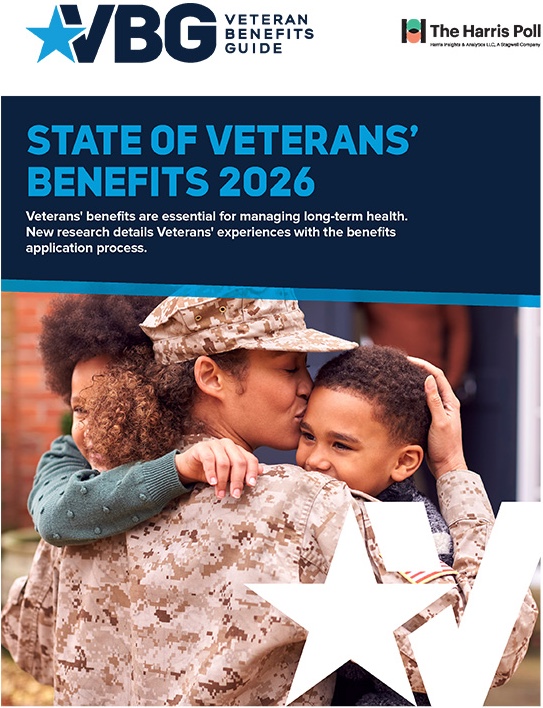
Veterans’ benefits are essential for managing long-term health. New research details Veterans’ experiences with the benefits application process.
63%
reported receiving less than they expected to receive.
70%
say they would pay a small fee if it meant getting their full benefits.
85%
say most Veterans deserve more support than what they’re getting.
METHODOLOGY
This study was conducted by The Harris Poll on behalf of Veteran Benefits Guide from Nov. 24, 2025 to Dec. 3, 2025. The survey included a total of 2,000 U.S. Veterans aged 18+ who had served at least one year in the military.
Surveyed Veterans by branch
Branch
Respondents
Percent
Army
954
45.3%
Navy
435
20.7%
Air Force
331
15.7%
Marine Corps
298
14.2%
Coast Guard
67
3.2%
Space Force
20
1.0%
Surveyed Veterans by group
Branch
Respondents
Percent
Post-9/11 Veterans
595
29.8%
Pre-9/11 Veterans
1,405
70.3%
Under-received Veterans
482
24.1%
EXECUTIVE SUMMARY
Veterans are often underserved by the complicated disability benefits application process, citing barriers to accessing or maintaining their benefits. Many say that excessive benefit wait times lead to both financial as well as a social and emotional costs.
Survey responses expose a vast gap between Veterans’ expectations regarding their benefits and the reality they receive. These outcomes are not inevitable: Veterans envision an improved disability benefits application process, including private industry partnerships, digital tools and simpler paperwork with clearer instructions.
The promise vs. reality
Benefits are seen as earned respect, not charity (96%). Yet 63% say they received less than expected, and 13% received little or none. Most (85%) believe other Veterans also deserve more support.
A system that’s too complex
Getting benefits is overwhelming: 93% say it feels like a full-time job, and 81% call it a “second deployment.” Most (84%) need help navigating the process, and 60% face access barriers.
The cost of delays
Delays create financial and emotional strain: 65% report financial harm (up to 80% post-9/11), with average losses around $18,600. Most (79%) say denials feel dismissive, and 63% report impacts to peace of mind.
Access, tools, and trust
Veterans support flexible access: 94% favor working with private partners to secure benefits. Most (95%) want simple digital tools, and 97% expect transparency in how their data is used.
Looking ahead
Veterans want full benefits and system improvements: 87% say it would improve their lives, and 74% cite emotional gains. Most (95%) say success strengthens the community, and 93% want better outcomes for future Veterans.
13%
of Veterans said they received very little or none of what they expected
96%
of Veterans agree with the statement “Every Veteran deserves a champion in their corner.”
87%
of Veterans cite that receiving their full benefits would improve their lives in some meaningful way.
THE BENEFIT PROMISE VS. THE VETERAN’S REALITY
Many Veterans say that they are not receiving the benefits they expect.

Benefits earned, benefits deserved
First, Veterans see their benefits as something they deserve: 96% of Veterans say that getting their benefits is a sign of respect, not an act of charity. When Veterans don’t receive benefits, or when they struggle to navigate the process, they can question if their service was truly appreciated. In fact, 68% agree that the benefits process made them question if their service was valued, and this number increased for under-received Veterans (88%) and post-9/11 Veterans (73%).
Access doesn’t mean success
Even those who do receive some benefits often say they’re not receiving what they expected. Out of the Veterans who say they’ve received benefits, 63% of Veterans report receiving less than what they expected; this goes up to 70% for post-9/11 Veterans. Additionally, over 10% of Veterans say they received very little to none of what they expected of their benefits. When Veterans’ do not receive the benefits they deserve, their view of the benefits system is damaged, as 76% reported feeling that the promise of benefits rings hollow, only honoring them with words more than actions. Millennial and Gen X Veterans especially relate to this, with 83% of each group agreeing.

Some benefits are good, but more are needed
Veterans often feel they lack sufficient benefits. 63% want more, especially financial (42%), health (38%), and career (28%) support. Many believe fellow Veterans face similar challenges, with 85% feeling support is inadequate for all. Under-received Veterans and post-9/11 Veterans find themselves especially in need of more benefits compared to their other vets.

Declining confidence in the benefits system
Their experience with the benefits process causes many Veterans to lose faith in the system, with 69% saying that if the Veterans’ benefits system was a business, they would not be a customer there. This increases to 76% of millennial and 76% of Gen X Veterans.
63%
reported receiving less than they expected to receive.
10%
say they received very little to none of what they expected of their benefits.
69%
say that if the Veterans’ benefits system was a business, they would not be a customer there.
THE TOO-COMPLEX SYSTEM
Veterans say that the benefits process is too complex and involves lengthy wait times, leading to financial and social-emotional costs.
Veterans didn’t sign up for this level of complexity
The vast majority of Veterans find the benefits process too complicated to navigate alone, with 93% saying the effort to get benefits feels like a full-time job. Another 81% say navigating benefits can “feel like a second deployment,” especially under-received Veterans (91%) and Gen X Veterans (87%).
Complexity was a major theme: 94% say paperwork shouldn’t be harder than basic training, and 84% say the process is too complicated to handle alone.
Benefits process delays
Time delays were another major complaint. Due to an inefficient process, 69% of all Veterans and 82% of millennial Veterans say they spend too much time waiting for answers or benefit updates. Systemic delays are common: 43% waited over six months to receive benefits, and 23% waited over 12 months.
Additionally, 60% of Veterans reported barriers to accessing or maintaining benefits, with slow response times or long decision waits the most cited barrier.
Patience gets tested by a confusing system
Over months and even years of navigating the complicated benefits process, Veterans find their patience tested. The strain wears them down, with 79% agreeing the process tested their patience more than boot camp. Over half reported administrative barriers to accessing or maintaining benefits (52%), rising to 72% among post-9/11 Veterans.
Furthermore, 61% of Veterans and 68% of Gen X Veterans feel lost, saying they are unsure where to find reliable benefits information.
Discouragement is a byproduct of confusion
When Veterans are confused, they often feel discouraged from pursuing the benefits they have earned. In fact, 68% of Veterans reported that they aren’t able to get the most out of their benefits, agreeing that paperwork and red tape discourage them from applying. This is especially true for under-received Veterans, with 85% saying they feel discouraged.
Among Veterans who have not applied for benefits, the top reason cited is that they don’t believe they qualify (36%). Furthermore, 22% say they don’t even know where to start, underscoring how confusion and complexity can prevent Veterans from accessing available support.
Post-9/11 Veterans struggle to find footing with the benefits process
As a group, post-9/11 Veterans especially feel slighted by the benefits system. Three quarters (75%) say they feel overlooked in the benefits conversation, while a similar share (73%) say the system was not built with their generation’s needs in mind.
This disconnect also shapes where they turn for help: 63% of post-9/11 Veterans say they rely more on online communities and social media than on traditional forms of Veteran support, suggesting many are seeking guidance outside the systems originally designed to serve them.
Navigating benefits can feel like another battle after service. Veterans say:
94%
Paperwork shouldn’t be harder than basic training.
93%
Getting Veterans’ benefits shouldn’t feel like a full-time job.
84%
It is too complicated to go through this process alone.
81%
Navigating Veterans’ benefits can feel like a second deployment.
VETERANS’ COSTS TAKE MANY FORMS
While Veterans can incur a significant financial cost while waiting for benefits, social-emotional and interpersonal costs are also high.

The big money loss of waiting
The estimated average financial loss for Veterans facing benefit wait times is $18,642, rising to over $20,000 for under-received Veterans. Some losses are much higher: 11% report losing over $250,000. Overall, 65% of Veterans reported financial impacts from waiting for or being denied benefits, especially post-9/11 Veterans (80%) and women Veterans (79%).
These delays have ripple effects: many fell behind on bills or debt payments (30%), dipped into savings or retirement funds (28%), or asked family or friends for financial help (24%).

The longer Veterans wait, the less confident they become
Long wait times also carry an emotional cost. Nearly eight in 10 Veterans (79%) say being denied benefits feels like “being dismissed by the system,” rising to 87% among Gen X Veterans.
Many also feel forgotten: 65% say waiting affected their outlook, including 71% of women Veterans and 71% of post-9/11 Veterans. Among those who have not applied, 20% say they do not feel their need is strong enough compared to others and do not want to take benefits away from another Veteran.

The social-emotional cost can also become a tension point at home
The emotional toll on Veterans can also affect loved ones at home, with 63% saying that waiting for benefits took a toll on their peace of mind. This is especially true for under-received Veterans (84%) and post-9/11 Veterans (73%).
Millennial Veterans have felt these costs most in daily life, with 76% reporting that waiting for benefits strained relationships at home. Overall, 48% say the benefits process has created strain in their homes.
$18,642
Estimated average financial loss for Veterans with benefit wait times.
$20,000+
This number jumps to over $20,000 for under-received Veterans.
GETTING RESOURCES IN THE RIGHT CORNERS
Veterans want to explore all pathways to receiving their benefits, including private partnerships.

Veterans want to see Veterans succeed
An overwhelming number support their fellow Veterans taking whatever actions they can to receive the benefits they have earned, with 96% agreeing that “Every Veteran deserves a champion in their corner.” Veterans also do not believe there is only one acceptable path to getting benefits; different people may need different kinds of support to successfully navigate the process. Overall, 95% agree that Veterans should have the right to choose who helps them access their benefits.

Veterans support private partnerships if they help fellow Veterans get their benefits
Veterans want multiple pathways to success, including government help and private partnerships. Most agree they should be able to work with private partners if it helps secure the benefits they deserve (94%), and 80% say private industry partnerships can greatly improve the benefits system.
Nearly all Veterans (96%) agree government and private companies should work together to better serve Veterans, while 85% say they should collaborate to modernize support. Among Veterans who had not heard of VBG, 68% are interested in learning more or using a private partner like VBG.

Veterans push to make the resources they use easier
Veterans want the benefits process made easier through modern digital tools and simpler paperwork. Specifically, 95% want simple, transparent tools that make benefits easier to understand and access. Many are willing to trade some financial burden for clarity: 70% would pay a small fee to receive their full benefits, rising to 82% of millennial Veterans, 78% of under-received Veterans, 77% of Gen X Veterans, and 75% of Marine Corps Veterans.
Their top priorities are faster decisions and wait times (46%) and simpler paperwork with clearer instructions (44%). Overall, 78% cite simplifying the process as the way to improve the system.
Veterans want transparent and secure access to their resources
While Veterans want digital tools, they remain concerned about data privacy. Nearly all (97%) say they should always know exactly how their personal information is being used by anyone assisting with their benefits. Human support also remains important, with 65% saying advocacy is a priority for improving the process, rising to 70% among under-received Veterans.
At the same time, convenience matters: 78% want to manage benefits entirely online or through an app. This is especially true for millennial (87%), Gen X (83%), post-9/11 (80%), women Veterans (83%), and Veterans in the Northeast (83%).
94%
of Veterans agree that they should be able to work with private partners if it helps them secure the benefits they deserve.
80%
of Veterans agree that private industry partnerships can greatly improve the Veterans’ benefit system.
CONCLUSION
It is clear there is a lot that is not working in the current benefits system. The complexity of the application process, long wait times, and the gap between benefits expected and benefits received all have negative effects on Veterans’ physical, emotional and financial health.
However, Veterans see a way forward. They are asking to work with private partners, use digital tools and receive simplified paperwork. Encouragingly, Veterans don’t just want support for themselves; they want the same support for other Veterans, too.
When they receive support, the positive benefits are significant and affect not only the Veterans themselves, but also their families and community.
94%
of Veterans say that when their benefits work, it helps their whole family, not just themselves.
87%
of Veterans say that receiving their full benefits would improve their lives in some meaningful way.
74%
of Veterans say it would help their emotional well-being.
68%
of Veterans say it would help their sense of trust and community.